Core guide
Online roulette rules: what changes the probability and payout?
Count the outcomes, separate profit from returned stake and read the zero rule before interpreting a roulette table or a run of results.
The useful first question is which roulette
An online roulette title can look familiar while its rules differ in a way that changes the arithmetic. A wheel image, a green zero and a recent-results strip are not a complete specification. Start with the named game, the number of pockets, the payout for the particular selection and the treatment of outcomes outside that selection. Keep those four facts together.
This guide uses deliberately small mathematical models. They explain why a denominator and a payout must agree; they do not certify a named casino or forecast the next result. We have not played or tested an operator for this guide. A public rules page is enough to begin a document check without opening an account or placing a wager.
The UK Gambling Commission’s remote standards address accessible game rules and payout information. Their practical relevance here is simple: use the actual game’s explanation rather than assume that a familiar title supplies every condition.
Sources: UK Gambling Commission: RTS 3 — Rules and likelihood of winning.
One number on a 37-pocket model
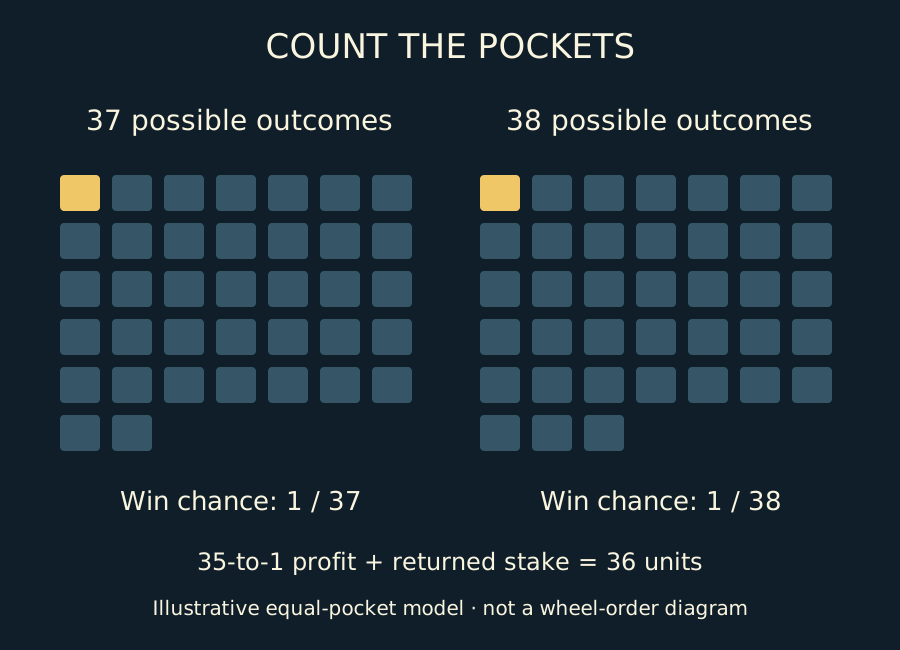
Assume a wheel has 37 equally likely pockets and your question concerns one specified number. The probability is one divided by 37, approximately 2.7027%. There are 36 other outcomes. This is a count of outcomes, not a percentage derived from the payout label.
Now suppose the profit payout is 35 to 1 and the original stake is returned with a win. A theoretical one-unit win returns 36 units in total: 35 profit plus the one-unit stake. Multiplying 36 by the probability of winning gives an expected gross return of 36/37 units. Subtract the initial unit to obtain a net expectation of −1/37, approximately −0.027027 units per unit staked.
Our shorter explanation of zero in the calculation focuses on that extra outcome. The broader point is that probability and settlement belong in the same calculation. Counting the winning pocket correctly while forgetting the returned stake still gives the wrong result.
Why the same payout changes on 38 pockets
Keep every assumption from the previous example except the pocket count. With 38 equally likely pockets, one specified number has probability 1/38, approximately 2.6316%. The winning gross return remains 36 units. The expected gross return becomes 36/38, and the expected net result becomes −2/38, approximately −0.052632 units.
Nothing about that subtraction requires a run of observed spins. It follows from the model’s stated outcome count and payout. The original diagram shows the difference as a pair of grids, not as a wheel-order illustration. Each coloured cell is one selected outcome; its physical position in the grid has no probability meaning.
The accompanying worksheet calculates these two exact cases. It intentionally offers no stake size, autoplay, simulated winnings or predicted number. Changing a payout, adding a special feature or abandoning equal likelihood would require a different model rather than a cosmetic change to the result.
Coverage describes an event; payout describes settlement
A selection covering several numbers changes the event being counted. Under an equal-pocket assumption, covering k distinct pockets gives probability k/N. The word distinct matters: two overlapping descriptions do not create two separate copies of the same pocket. Count the actual union of outcomes.
The Massachusetts regulator’s published roulette rules provide a useful comparative payout record: a straight-up wager pays 35 to 1, a split 17 to 1, and a dozen 2 to 1. These examples are not a guarantee about an online title in Britain. They illustrate why you must read the exact payout beside the exact coverage.
For an invented audit of a 12-number selection on 37 equally likely pockets paying 2 to 1 profit, the winning gross return is three units. Its expectation is (12/37) × 3 = 36/37 gross units. That equality with the one-number example comes from these assumptions; it should not be extended to every wager or variant.
Consider a separate counting exercise involving two labels. The first label covers numbers 1, 2 and 3; the second covers 3, 4 and 5. Together they describe five distinct outcomes, not six. Number 3 appears in both descriptions, but there is still only one pocket numbered 3. The chance of an outcome in either set is therefore 5/N under the equal-pocket assumption. Settlement is a further question: if two separate wagers were involved, the overlapping outcome might settle both. Keep event counting and the amounts attached to those events separate rather than treating coverage as a complete payout table.
Read the zero clause as a condition, not a nickname
A label such as European or American is less precise than a written pocket count and settlement rule. The comparative Massachusetts document allows different treatment of zero and double zero on certain even-money wagers at double-zero tables: either half or all of the stake can be lost under the stated option. It also describes the single-zero condition separately.
That is enough to show why “zero always does the same thing” is an unreliable shortcut across rule sets. It does not establish which option a particular online operator offers. Record the game’s own clause, its applicability and any exception before deriving an expectation.
The worksheet avoids this ambiguity by considering only its expressly defined one-number wager. If you want to investigate an even-money rule, first specify what happens to the entire stake on every outcome, including any return, partial loss or deferred settlement. A probability without that settlement map cannot answer the financial arithmetic.
A worksheet comparing exact gross return and net expectation on 37 or 38 equally likely pockets.
A recent-results strip cannot repair a missing rule
Suppose an illustrative independent, fixed-probability model produces the same colour five times. The model has not changed merely because the display now contains a run. A claim that the opposite colour is due adds an assumption that is absent from the model.
This does not mean that a results strip proves independence or fairness. It establishes neither. A screenshot of several outcomes is a limited observation; the game’s specified mechanism, relevant testing evidence and appropriate statistical analysis answer different questions. Our separate note on roulette streaks explains that evidence boundary.
Keep the two errors apart. Treating a streak as a prediction invents a relationship. Treating an absence of an obvious streak as proof of fairness invents a different conclusion. Neither follows from counting the coloured entries visible on a short screen.
Do not call a model average a session result
The negative expectation in the examples is a weighted mathematical average. It does not say that a one-unit wager literally loses 0.027027 units when settled. In the specified one-number model, it either loses one unit or makes 35 units of profit. The average combines those possible outcomes using their probabilities.
Likewise, multiplying the expectation by a stated number of model trials produces an expected aggregate result, not a promised loss limit. It does not set the range of an individual session or prevent a much larger loss. A system that changes stake sizes also changes the amounts exposed; it does not remove the underlying assumptions from the individual wager calculation.
This distinction is useful when reading claims about systems. Ask which outcome probability or settlement rule has actually changed. A sequence of different stake amounts is not, by itself, evidence that either has changed.
Treat the online interface as a record of stages
An online selection, an accepted wager and a displayed result are different things. If an interface becomes unclear, avoid treating a coloured chip or animation as a complete settlement record. Preserve the game identity, time and available transaction or round reference for a factual enquiry, without exposing private account information publicly.
RTS 5 concerns processing and settlement according to the relevant published rules. It does not let this guide infer how a particular interrupted round was handled. The actual operator record and applicable rules would be needed to investigate that case.
For a document comparison, place the rules date and the observation date together. A later version of a help page should not silently replace the rule version relevant to an earlier event. If the version is unavailable, say so rather than filling the gap with a rule from another game.
Sources: UK Gambling Commission: RTS 5 — Result determination.
A compact rule record you can actually use
Write one sentence containing the full model before any result: “This example has 37 equally likely pockets, covers one number, pays 35 to 1 profit and loses the full stake on every other outcome.” That sentence makes the calculation reproducible. A reader can see exactly which change would require it to be redone.
For an actual online rules document, add the exact game title, provider where identified, page address and access date. Separate a stated rule from your own calculation and from an observation of the interface. Leave any missing payout or zero clause unresolved.
The aim is a comprehensible explanation of the rules, not a ranking of casinos or a method for beating roulette. Once the conditions are explicit, the arithmetic can be checked. When they are not, the most accurate result is that the available information does not yet support the proposed calculation.
Questions answered
Does 35 to 1 mean a 1-in-35 chance?
No. It describes a profit payout. In the stated 37-pocket equal-likelihood example, one selected number has a 1-in-37 chance; a win returns 35 profit units plus the original unit.
Is every roulette game with two zeroes identical?
No. Pocket count alone does not specify every payout and settlement rule. Check the exact game, including the applicable zero treatment and any special features.
Can this calculator predict a spin?
No. It evaluates two expressly stated mathematical models and contains no live game connection or prediction mechanism.