Facts checked Article
Roulette literacy
Streaks and roulette strategies: are there any that work better on European wheels than American ones?
No. A run of reds is a record of spins that have already settled. The wheel sets the rate: 2.70% of every pound staked on a 37-pocket wheel, 5.26% on a 38-pocket one, whatever pattern the stakes follow.
Pocket 0 — a run of reds describes spins that have already settled
A run of reds is a record. It describes spins that have already settled, and it says nothing about the next one. So the honest answer to whether there are any roulette strategies that work better on European wheels than American ones is no.
The wheel sets the rate. A single-zero wheel has 37 pockets, and it takes 2.70% of every pound staked. A double-zero wheel has 38 pockets, and it takes 5.26%.
No betting pattern moves either figure. A pattern changes how much you stake and how wide the swings feel. The rate stays where the pocket count put it.
This page works both sums. It then checks a run against the wheel it came from, and says what a results panel can and cannot tell you.
Sources: Massachusetts Gaming Commission: roulette rules; Légifrance: Article 51, casino games order.
The four numbers this page works with
- Single-zero wheel
- 37 pockets. French casino regulation allows only "roulettes à trente-six numéros et un zéro" and describes a plate "divisé en 37 cases".Légifrance: Article 51, casino games order · as checked on
- Double-zero wheel
- 38 pockets. The Massachusetts rules set out how every bet settles when the ball lands in zero or double zero.Massachusetts Gaming Commission: roulette rules · as checked on
- Chance of red
- 18 in 37 is 48.65% on the single-zero wheel; 18 in 38 is 47.37% on the double-zero wheel.Légifrance: Article 51, casino games order · as checked on
- What a previous spin changes
- Nothing. Of random gaming machines the Commission states that "The odds of achieving a win in the current game remain constant and are not affected by wins or losses in previous games".Gambling Commission: return to player · as checked on
Regulator wording read on 23 September 2026. The percentages are our own arithmetic on the pocket counts those regulators publish.
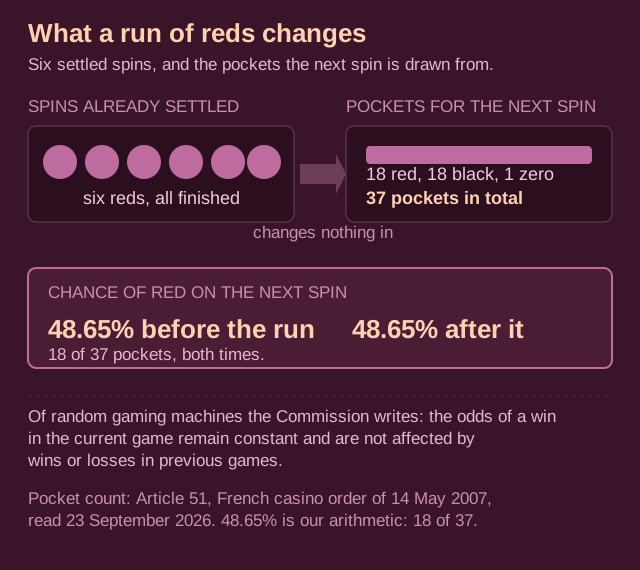
Pocket 1 — the pockets the next spin is drawn from
Every spin is drawn from the same pockets. On a single-zero wheel there are 37 of them, and the number is set by regulation rather than by custom.
Article 51 of the French casino order of 14 May 2007 states that the only wheels allowed are "roulettes à trente-six numéros et un zéro". The same article describes a plate "divisé en 37 cases". That is 36 numbers and one zero.
Eighteen of those pockets are red. So red lands 18 times in 37, which is 48.65%. A double-zero wheel adds a pocket, and red becomes 18 in 38, or 47.37%.
Neither figure depends on the last spin. Writing about random gaming machines, the Gambling Commission puts the same point plainly: "The odds of achieving a win in the current game remain constant and are not affected by wins or losses in previous games."
That sentence is the whole of the answer to a run, because nothing keeps score between the spins and nothing is owed back afterwards.
Sources: Légifrance: Article 51, casino games order; Gambling Commission: return to player.
Pocket 2 — what a run is worth before it happens
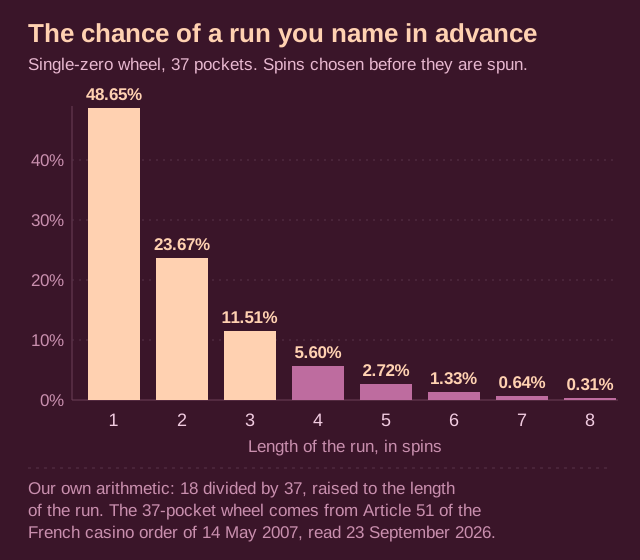
Name the spins before they are spun and the sum is short. For each spin in the run, multiply by 18/37.
Two reds named in advance come to 23.67%, three come to 11.51%, and six come to 1.33%, which is roughly one run in 75.
Ten in a row come to 0.07%, or roughly one run in 1,347. The figure falls away quickly, because each spin is a fresh draw from the same 37 pockets.
None of that makes the eleventh spin different, because the run was improbable taken as a whole while the spin that follows it is the ordinary 48.65%.
So a long run is rare and uninformative at the same time. Those two things are not in tension; they are answers to two different questions.
Pocket 3 — the question a results panel cannot answer
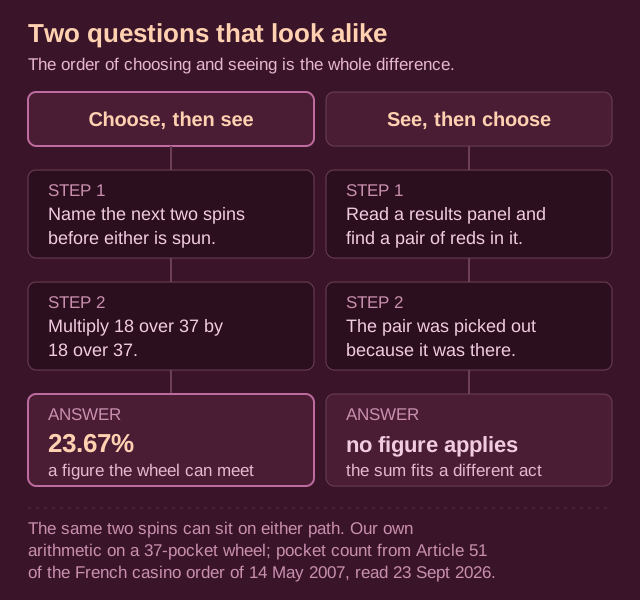
A results panel shows spins that have already happened. Picking a pair of reds out of it is not the same act as naming two spins in advance.
The multiplication above describes the first act, in which you choose and the wheel then answers. In the second act you see the result first, and afterwards choose it.
That is why 23.67% does not attach to a pair you spotted in a panel. The pair was selected because it was there.
The same two spins can sit in either story. Only the order of choosing and seeing differs, and that order is the whole of the difference.
This is worth holding on to, because a panel is designed to be scanned. A run you notice has already passed the filter of being noticeable.
Sources: Gambling Commission: return to player.
Pocket 4 — are there any roulette strategies that work better on European wheels than American ones?
No, and the reason is short: an expected cost is a rate per pound staked, and rates accumulate across every bet in an evening.
Every standard bet on a single-zero wheel costs 2.70% of its stake. Stake £1,000 across an evening, in any order and in any size, and the expected cost is £27.03.
A doubling pattern does not escape that. Doubling a £10 stake after each loss puts £630 on the table across six spins. The expected cost is 2.70% of £630, which is £17.03.
On a double-zero wheel the same £630 has an expected cost of £33.16, because the wheel changed the rate while the pattern did not.
So the only choice on this page that moves the number is the pocket count. A lower rate is still a cost, not a profit. It changes what the same stake is expected to cost, and nothing else.
Sources: Massachusetts Gaming Commission: roulette rules; Légifrance: Article 51, casino games order.
What a run of bets is expected to cost, on either wheel
Enter a stake per spin, a number of spins, and how many zero pockets the wheel has. The tool gives the total staked and the expected cost of staking it.
Worked example: with stake per spin £10.00, number of spins 100, zero pockets on the wheel 1, total staked is £1,000.00 and expected cost, as a share of the stake is 2.70% and expected cost of the run is £27.03. A £10 stake over 100 spins on a single-zero wheel: £1,000 staked, an expected cost of £27.03.
Arithmetic on the pocket count you enter. It is an average over very many spins, not a prediction of one session, and it describes no named game.
Pocket 5 — the same run, priced on both wheels
A run is rarer on a double-zero wheel, because red itself is rarer there. Red is 18 in 38, not 18 in 37.
The table below names a run in advance and prices it on both wheels. The two columns track each other closely all the way down.
That closeness is the point. The difference between the wheels shows up in the cost of betting, not in the shape of the runs a reader notices.
The zero itself settles an even-money bet the same way on both wheels unless a published rule says otherwise. The Massachusetts rules state that on a single zero wheel "wagers on red, black, odd, even, 1 to 18, and 19 to 36 shall be lost" when the ball comes to rest in the zero compartment.
On a double zero wheel the same rules let a licensee take half instead. A player loses "at the gaming licensee's option, either one-half of each wager on red, black, odd, even, 1 to 18, and 19 to 36 or the entire wager".
That option is a rule rather than a pattern, and it is the only thing on this page that moves a single bet's rate. It is also written down in advance, which is what makes it checkable.
Read the table as a description of the wheel rather than of an evening. It says how often a named run occurs over very many spins. It does not say when.
Sources: Légifrance: Article 51, casino games order; Massachusetts Gaming Commission: roulette rules.
How often a named run of reds occurs
| Length of the run (spins) | Single-zero wheel, 37 pockets (%) | Double-zero wheel, 38 pockets (%) | Roughly one run in | Evidence |
|---|---|---|---|---|
| 1 | 48.65% | 47.37% | 2 (single-zero) | · Légifrance: Article 51, casino games order |
| 2 | 23.67% | 22.44% | 4 (single-zero) | · Légifrance: Article 51, casino games order |
| 3 | 11.51% | 10.63% | 9 (single-zero) | · Légifrance: Article 51, casino games order |
| 4 | 5.60% | 5.03% | 18 (single-zero) | · Légifrance: Article 51, casino games order |
| 6 | 1.33% | 1.13% | 75 (single-zero) | · Légifrance: Article 51, casino games order |
| 8 | 0.31% | 0.25% | 319 (single-zero) | · Légifrance: Article 51, casino games order |
| 10 | 0.07% | 0.06% | 1,347 (single-zero) | · Légifrance: Article 51, casino games order |
This is the table to keep. It prices a run you name in advance, and it says nothing about a run you have already watched.
Pocket 6 — what the rules require of a licensed wheel
A Great Britain licence brings two requirements that bear on this page directly. Both sit in the Gambling Commission's remote technical standards.
The first is about the result. RTS aim 7 is "To ensure that games and other virtual events operate fairly", and requirement 7A is that "Random number generation and game results must be 'acceptably random'".
The standard also blocks a wheel that reacts to a run. Numbers "are not to be discarded, unless they fall outside the expected range of numbers required by the virtual event". And "Where a virtual event simulates a physical device, the theoretical game probabilities should match the probabilities of the real device".
The second requirement is about disclosure. RTS 3A states that "An explanation of the applicable rules must be easily available to the customer before they commit to gamble". Requirement 3C adds the house edge, the return to player percentage or the probability of winning events.
So the pocket count and the zero clause are things you are entitled to read before you bet, not things to infer from a run.
Sources: Gambling Commission: RTS 7; Gambling Commission: RTS 3.
The standard that rules out a wheel reacting to a run
Where a virtual event simulates a physical device, the theoretical game probabilities should match the probabilities of the real device.
Pocket 7 — how to check a run against the wheel yourself
The check takes a minute, and it needs nothing but the game's own rules page.
The steps below turn a run you have just watched into a number. The last step says what that number does not mean.
Write the figures down with the date you read them. A rules page can change, and the date is the claim.
Sources: Gambling Commission: RTS 3.
From a run you watched to a number you can check
Five steps, in order. Step 5 is the one that matters most.
Find the rules page
Open the game's rules before you bet. Under RTS 3A an explanation of the applicable rules must be easily available at that point.
If the rules are not there before you commit, the disclosure the standard asks for has not been made.
Count the zero pockets
One zero means 37 pockets. A zero and a double zero mean 38. Three zeros mean 39.
Write down the chance of the colour
Red is 18 of the pockets on every wheel here. That is 48.65% on 37 pockets and 47.37% on 38.
Price the run you watched
Multiply that figure by itself once for each spin in the run. Six reds on a single-zero wheel comes to 1.33%.
Read what the number means
It is the chance of that run when the spins are named in advance. It is not the chance of the next spin, which is still 48.65%.
A run you found by looking at a panel was chosen after the result, so the figure does not describe it at all.
What the wheel cannot tell you
A run cannot tell you what the next spin will do. It cannot tell you that a number is owed, and it cannot tell you that the equipment is faulty.
A short sequence is too small to test equipment. Establishing a bias needs a long recorded series and a test designed before the data is collected.
We did not measure any wheel to write this page. Every probability here is arithmetic on a published pocket count, and every pound figure is arithmetic on a published payout.
None of that is a reason to keep going. Choosing not to bet is the only outcome on this page whose cost you know before it happens.
A losing run is the ordinary shape of independent draws, not a sign that a win is near. If a run has taken more than you planned, GamCare's helpline is 0808 8020 133.
Sources: Gambling Commission: self-exclusion.
Five things a run of results does not establish
Each line is the negative of a claim this page tested. Ticks stay in your browser and are not sent anywhere.
- That a longer session makes a loss less likely. More spins means more staked, and the expected cost rises with it.
Ticks are kept only in this browser and are never sent anywhere.
Sources checked 23 September 2026
We read six pages on 23 September 2026. Every figure above either traces to one of them or is marked as our own arithmetic.
The Massachusetts Gaming Commission's roulette rules supplied the payout odds and the two clauses that settle a bet on zero. Article 51 of the French casino order supplied the 37-pocket single-zero wheel.
The Gambling Commission supplied three things: the sentence on previous games, the random-outcome standard, and the disclosure standard. Its self-exclusion page supplied the helpline number.
The probabilities, the 48.65% and 47.37% figures and the pound amounts are our own arithmetic on those published rules. We did not measure any wheel, and we did not deposit, wager or withdraw anything to write this page.
Sources: Massachusetts Gaming Commission: roulette rules; Légifrance: Article 51, casino games order; Gambling Commission: return to player; Gambling Commission: RTS 7; Gambling Commission: RTS 3; Gambling Commission: self-exclusion.
The words the arithmetic uses
- Independent draw
- Each spin starts from the same pockets, whatever the last one did. Of random gaming machines the Commission writes that the odds in the current game are not affected by wins or losses in previous games.
- Named in advance
- A run whose spins you choose before they are spun. Only a run named this way has the probability the multiplication gives.
- Selected after the fact
- A run picked out of a results panel because it was already visible. The same multiplication does not describe it.
- Expected cost
- A rate per pound staked, not a forecast of an evening. On a 37-pocket wheel it is 2.70% of everything staked; on 38 pockets it is 5.26%.
- Pocket count
- The number of compartments on the wheel: 37 with one zero, 38 with a zero and a double zero. It fixes the rate on every standard bet.
- House edge
- The same rate seen from the operator's side: the share of each pound staked that the wheel is expected to keep over very many spins. The Commission calls it a measure of the percentage a casino would expect to keep, on average, from each hand or spin.
- Return to player
- The Commission describes it as part of the money paid to play a machine that is then given back to the player as prizes, averaged over a significant number of plays. It is the same idea as the edge, counted from the other end.
- Self-exclusion
- A formal agreement with an operator or a scheme not to gamble for a set period. The Commission calls it a tool used by those who have recognised that their gambling is harmful to them.
Questions answered
Are there any roulette strategies that work better on European wheels than American ones?
No. The rate is fixed by the pocket count: 2.70% of every pound staked on a 37-pocket wheel and 5.26% on a 38-pocket wheel. A betting pattern changes how much is staked and how wide the swings feel, not the rate.
Does a run of reds make black more likely on the next spin?
No. The next spin is drawn from the same 37 pockets, so red is 48.65% and black is 48.65% again. Of random gaming machines the Gambling Commission states that the odds of a win in the current game are not affected by wins or losses in previous games.
What are the odds of ten reds in a row on a single-zero wheel?
About 0.07%, or roughly one run in 1,347, when the ten spins are named before they are spun. On a double-zero wheel it is about 0.06%. Both figures are our own arithmetic on the pocket counts.
Does doubling a stake after a loss lower the house edge?
No. Doubling a £10 stake after each loss puts £630 on the table across six spins. The expected cost is 2.70% of that on a single-zero wheel, which is £17.03, and 5.26% of it on a double-zero wheel, which is £33.16.
How do I tell which wheel an online game uses?
Read the game's own rules page and count the zero pockets. Under RTS 3A an explanation of the applicable rules must be easily available to the customer before they commit to gamble.
Rule sources
Continue reading
Best free roulette payout chart: every bet’s edge, computed from the wheel
A roulette payout chart is only complete when it shows the true odds beside the payout, because the gap between them is the edge. Every standard bet, both wheels, the working, and a £10 cost per spin.
Read Best free roulette payout chart: every bet’s edge, computed from the wheel
La partage and en prison settle the same zero differently
Compare immediate half-refunds with held roulette stakes, follow a £20 settlement example and see why repeated-zero wording changes the question.
Read La partage and en prison settle the same zero differently
Overlapping roulette bets need a whole-layout payout calculation
A worked roulette ledger separates winning chips from net profit, counts overlapping numbers once and shows why covering red and black leaves a zero loss.
Read Overlapping roulette bets need a whole-layout payout calculation
European vs American roulette: what actually changes the odds
European and American wheels do not just differ by a pocket. Every bet's edge moves with the zero count, and la partage or surrender change only one bet type. The numbers, worked and sourced.
Read European vs American roulette: what actually changes the odds
The zero belongs in the calculation
A single-zero wheel has 37 pockets and pays a straight-up bet 35 to 1. Put those two numbers in one sum and every standard bet loses about £0.27 for each £10 staked.
Read The zero belongs in the calculation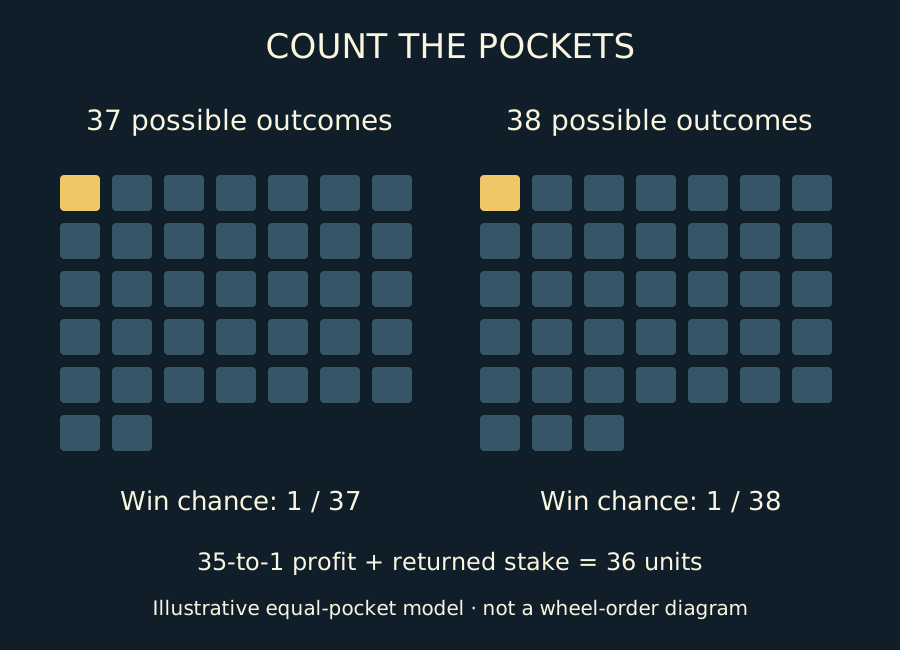
Online roulette rules: what changes the probability and payout?
Count the outcomes, separate profit from returned stake and read the zero rule before interpreting a roulette table or a run of results.
Read Online roulette rules: what changes the probability and payout?
Continue reading
Best free roulette payout chart: every bet’s edge, computed from the wheel
A roulette payout chart is only complete when it shows the true odds beside the payout, because the gap between them is the edge. Every standard bet, both wheels, the working, and a £10 cost per spin.
Read Best free roulette payout chart: every bet’s edge, computed from the wheelLa partage and en prison settle the same zero differently
Compare immediate half-refunds with held roulette stakes, follow a £20 settlement example and see why repeated-zero wording changes the question.
Read La partage and en prison settle the same zero differentlyOverlapping roulette bets need a whole-layout payout calculation
A worked roulette ledger separates winning chips from net profit, counts overlapping numbers once and shows why covering red and black leaves a zero loss.
Read Overlapping roulette bets need a whole-layout payout calculationCompare roulette wheel assumptions
The zero belongs in the calculation
European vs American roulette: what actually changes the odds
Best free roulette payout chart: every bet’s edge, computed from the wheel
La partage and en prison settle the same zero differently
Online roulette rules: what changes the probability and payout?
Overlapping roulette bets need a whole-layout payout calculation