Facts checked Article
Roulette literacy
Overlapping roulette bets need a whole-layout payout calculation
A worked roulette ledger separates winning chips from net profit, counts overlapping numbers once and shows why covering red and black leaves a zero loss.
A winning chip can sit inside a losing round
On an online roulette layout, a paid winning bet does not establish that the whole round made a profit. Other chips on the same spin may have lost. Add the returns from every winning position, then subtract everything staked on that spin.
This is the calculation that a payout chart alone cannot do for you.
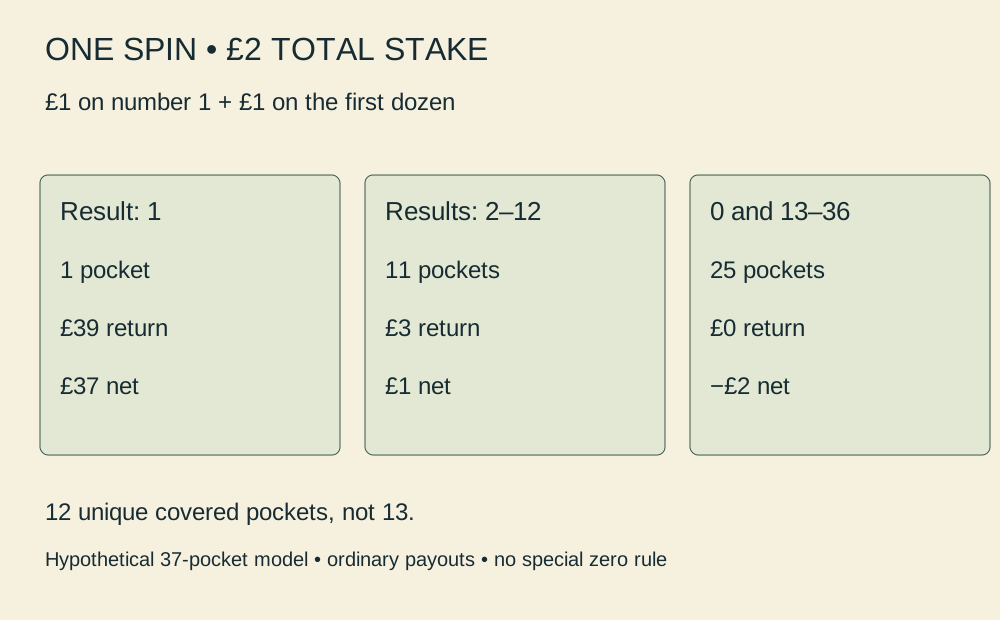
Consider a deliberately small paper example: £1 on the number 1 and £1 on the first dozen, covering 1 to 12. The total stake is £2. A result of 1 wins both positions; a result from 2 to 12 wins only the dozen; every other pocket loses both.
There are three settlement cases even though the screen shows only two selections.
The ordinary 35:1 straight-up and 2:1 dozen payouts used here appear in the Massachusetts Gaming Commission's roulette rules and PokerStars' online rules. The Massachusetts document is a published rule example, not UK law. No account was opened and no wagers were placed for this article.
All amounts below are constructed examples under explicitly stated payouts.
Sources: Roulette rules, 8 October 2020; Roulette Rules - Learn How to Play Roulette.
Pocket index — the whole-round rule and its inputs
- The whole-round rule
- Add the returns from every winning position, then subtract everything staked on that spin. A payout chart alone cannot do this for you.Roulette rules, 8 October 2020 · as checked on
- The paper example
- £1 on the number 1 and £1 on the first dozen, covering 1 to 12. The total stake is £2 and there are three settlement cases even though the screen shows only two selections.Roulette rules, 8 October 2020 · as checked on
- Payouts used
- The ordinary 35:1 straight-up and 2:1 dozen payouts, as they appear in the Massachusetts Gaming Commission's roulette rules and PokerStars' online rules.Roulette Rules - Learn How to Play Roulette · as checked on
- Status of the Massachusetts document
- A published rule example, not UK law.Roulette rules, 8 October 2020 · as checked on
Constructed examples under explicitly stated payouts. No account was opened and no wagers were placed for this article.
Write the stake beside each selection
Our method is a pocket-by-pocket settlement ledger. First list each selection, its stake and its winning numbers. Next calculate the total returned for each possible result.
Finally deduct the same total stake in every row. That last step prevents the cost of losing positions from disappearing when a winning position is highlighted.
A payout of 35:1 means £35 profit on a winning £1 straight-up stake, plus the £1 stake returned. The corresponding gross return is £36. At 2:1, a winning £1 dozen returns £3 including its stake.
Those are the two inputs to the ledger; neither is a promise about a particular spin.
Use pounds throughout the example, rather than alternating between chips and pounds. A chip icon describes a selected denomination, while the round may contain several chips or several placements. If a saved selection adds multiple positions, count the amount attached to each.
A label such as one bet is not a reliable substitute for a total expressed in money.
Sources: Roulette Rules - Learn How to Play Roulette.
How to build the pocket-by-pocket settlement ledger
The same method works on paper without opening an account.
List each selection
Write each selection with its stake and its winning numbers, in pounds throughout rather than chips.
Calculate the return for each result
For every possible result, add the gross return of each winning position: 35:1 on a £1 straight-up returns £36 including stake; 2:1 on a £1 dozen returns £3.
Deduct the same total stake in every row
That last step prevents the cost of losing positions from disappearing when a winning position is highlighted.
Expand any shortcut first
If a saved selection or racetrack action adds multiple positions, count the amount attached to each component before doing the arithmetic.
What the result means
Each row is the whole round's financial result, not a winning chip's payout. A £39 return on the number 1 is £37 profit once the £2 commitment is deducted.
Three outcomes for the £2 overlap
The table groups pockets only where their settlement is identical. We assume an ideal single-zero wheel with 37 equally likely pockets, ordinary payouts, and no multiplier or special refund. These assumptions make the calculation reproducible; they do not certify any named game's implementation.
On 1, the £39 returned is not £39 profit: £2 was committed. On 7, the dozen's £2 profit is partly offset by the lost £1 straight-up bet, leaving £1 overall. On 0, neither selection covers the result.
The coverage is twelve unique pockets, not thirteen: number 1 appears in both selections but remains one physical outcome.
This is why adding the advertised coverage of overlapping bets gives the wrong answer. List the union of the winning numbers before counting it. Then keep the different payout amounts within that union separate.
| Result group | Pockets | Straight-up return | Dozen return | Total return | Net after £2 stake |
|---|---|---|---|---|---|
| 1 | 1 | £36 | £3 | £39 | +£37 |
| 2 to 12 | 11 | £0 | £3 | £3 | +£1 |
| 0 and 13 to 36 | 25 | £0 | £0 | £0 | −£2 |
Sources: Roulette rules, 8 October 2020.
Count money returned as well as winning pockets
The same example gives a transparent check on the theoretical average. Sum the net results across all 37 equally likely pockets: one times £37, plus eleven times £1, minus twenty-five times £2. The total is minus £2.
Dividing by 37 gives an expected loss of £2/37, approximately 5.405p per hypothetical £2 round.
Relative to the full £2 stake, that is 1/37, approximately 2.703%. It is not a forecast that a particular balance will fall by five pence after one spin. The table permits only the three net outcomes shown; none is a five-pence loss.
The average comes from weighting those possible outcomes, not from observing a session.
Overlap has therefore changed where the money is concentrated without removing the cost built into these payouts. Twelve pockets return a net profit, but one of those pockets returns much more than the other eleven. A description that says only twelve winning numbers leaves out that difference.
A description that quotes only the £39 maximum return leaves out both its one-pocket condition and the £2 commitment.
Sources: Roulette rules, 8 October 2020.
Covering red and black still leaves a settlement case
A second paper calculation exposes a different misunderstanding. Suppose £5 is placed on red and £5 on black, with ordinary 1:1 payouts and full loss on zero. On any red result, the red position returns £10 and the black position returns nothing.
Total return is £10 against £10 staked: no profit. A black result produces the same net result.
On zero, both positions lose, so the net result is minus £10. Across the 37-pocket model the average is therefore −£10/37, approximately −27.027p per £10 round. Thirty-six pockets avoid a net loss; none produces a net gain.
Describing this as a 36-in-37 chance of winning confuses a returned balance with profit.
The zero clause is part of this calculation. A genuine half-loss or other protection rule would require a different zero row. It cannot be imported because the game is called European, because a neighbouring table offers it, or because the first example used a single-zero wheel.
This comparison concerns the full-loss rule only, with no claim that covering opposite colours is a useful gambling strategy.
Sources: Roulette rules, 8 October 2020.
£5 on red plus £5 on black, full-loss zero rule
| Result | Red position returns | Black position returns | Total return against £10 staked | Net result | Evidence |
|---|---|---|---|---|---|
| Red | £10 | nothing | £10 | no profit | · Roulette rules, 8 October 2020 |
| Black | nothing | £10 | £10 | no profit | · Roulette rules, 8 October 2020 |
| Zero | nothing | nothing | nothing | minus £10 | · Roulette rules, 8 October 2020 |
This comparison concerns the full-loss rule only, with no claim that covering opposite colours is a useful gambling strategy. A half-loss or other protection rule would need a different zero row.
One racetrack action may contain several wagers
PokerStars' rules provide an online example of why the action count and stake count can differ. Its racetrack describes neighbour selections and named combinations that distribute multiple chips across the layout. The page gives Voisins du Zero a nine-chip cost.
That describes nine chip units, not nine pounds regardless of denomination.
At a hypothetical £2 denomination, nine units commit £18. That multiplication establishes the amount at stake; it says nothing yet about the return for a particular pocket. A complete reconstruction would need every component placement and its payout.
Do not substitute the name of the group for that list, or assume that all covered pockets produce identical returns.
This article does not reproduce an entire racetrack chart. The useful extension of the method is to expand any shortcut into its component positions before doing the arithmetic. If two components cover the same number, their returns both belong in that number's row.
If a component loses there, its cost still belongs in the total stake deducted at the end. The interface shortcut does not create an extra outcome on the wheel.
Keep special products outside the ordinary chart
A settlement ledger is reusable; its inputs are not universal. The worked rows use ordinary straight-up and dozen payouts. They do not cover multiplier roulette, a separate feature fee, changing straight-up payouts, special zero treatment or a side wager.
If one of those applies, replace the affected input before calculating anything.
For a document check, record the game title, the rule version or retrieval date, wheel pockets, selections, stake per selection and payout basis. Write whether a figure is profit or a return including stake. A screenshot of a large paid amount may omit the total commitment and the losing selections; it cannot fill those gaps by itself.
Stop the reconstruction where the evidence stops. If the record supplies only a net balance change, it may not identify which component won. If it supplies only a result number, it cannot identify which selections were accepted.
Those are missing inputs, not reasons to guess a layout. This is an accounting exercise for roulette rules, not a test of a site's transaction system or a prediction method.
Sources: Roulette Rules - Learn How to Play Roulette.
Document check — what to record before calculating
A screenshot of a large paid amount may omit the total commitment and the losing selections; it cannot fill those gaps by itself.
Ticks are kept only in this browser and are never sent anywhere.
Read the round as one financial result
Before interpreting a roulette payout, answer three concrete questions: what was the full stake, which of those positions won, and did the displayed amount include returned stakes? In the overlap example those answers convert a headline £39 return into £37 profit, and a dozen's £3 return into £1 profit across the round.
For red and black together, the same method shows why frequent returned stakes do not create frequent profits. A complete table includes zero even when the betting areas being discussed are red and black. Omitting an inconvenient outcome changes the calculation, not the game.
The diagram accompanying this article illustrates these two ledgers with original labels and arithmetic. It is not a product screenshot or evidence of real play. The method can be repeated on paper without opening an account.
Reading the money correctly can resolve a misunderstanding about a past result; it does not make a future result controllable. Gambling can cause harm, and a theoretical cost is not a spending target.
Three questions before interpreting a payout
In the overlap example these answers convert a headline £39 return into £37 profit.
Ticks are kept only in this browser and are never sent anywhere.
Terms used on this page
- Gross return
- The money that comes back on a winning position, including its stake.
- Net profit
- All gross returns for the round minus everything staked on that round.
- Settlement
- How each position is paid or lost once the result is known; overlapping positions settle separately.
- Union of winning numbers
- The set of pockets covered by at least one selection, with a shared pocket counted once.
- Expected loss
- The average net result across all equally likely pockets; a weighted average, not a forecast for one spin.
- Full-loss zero rule
- The ordinary rule under which every position loses when zero lands, with no half-refund or held stake.
Questions answered
Can you bet on red and black together in roulette?
Where the game permits both selections, their combined settlement still needs to include zero. In our full-loss single-zero example, £5 on each returns £10 on a coloured pocket, equal to the £10 staked, and loses £10 on zero.
How much would I win if I bet £100 on red?
At ordinary 1:1 settlement a winning £100 red position returns £200 including stake, so its profit is £100. Any other losing positions on the same spin reduce the whole-round profit.
What is the smartest bet in roulette?
No selection in this model guarantees profit. The overlap example changes the distribution of returns but retains the 1/37 theoretical loss fraction for its ordinary single-zero bets.
What is the riskiest bet in roulette?
First specify whether risk means chance of losing a round, possible loss or theoretical cost. Covering red and black in our example avoids a loss on 36 pockets but never produces a profit, showing why one label is insufficient.
Why do the first dozen and number 1 cover twelve pockets, not thirteen?
Number 1 appears in both selections but remains one physical outcome. List the union of the winning numbers before counting it, then keep the different payout amounts within that union separate.
What is a gross return?
The money that comes back on a winning position including its stake: a winning £1 straight-up bet at 35:1 returns £36, and a winning £1 dozen at 2:1 returns £3.
Rule sources
Continue reading
Streaks and roulette strategies: are there any that work better on European wheels than American ones?
No. A run of reds is a record of spins that have already settled. The wheel sets the rate: 2.70% of every pound staked on a 37-pocket wheel, 5.26% on a 38-pocket one, whatever pattern the stakes follow.
Read Streaks and roulette strategies: are there any that work better on European wheels than American ones?
Best free roulette payout chart: every bet’s edge, computed from the wheel
A roulette payout chart is only complete when it shows the true odds beside the payout, because the gap between them is the edge. Every standard bet, both wheels, the working, and a £10 cost per spin.
Read Best free roulette payout chart: every bet’s edge, computed from the wheel
La partage and en prison settle the same zero differently
Compare immediate half-refunds with held roulette stakes, follow a £20 settlement example and see why repeated-zero wording changes the question.
Read La partage and en prison settle the same zero differently
European vs American roulette: what actually changes the odds
European and American wheels do not just differ by a pocket. Every bet's edge moves with the zero count, and la partage or surrender change only one bet type. The numbers, worked and sourced.
Read European vs American roulette: what actually changes the odds
The zero belongs in the calculation
A single-zero wheel has 37 pockets and pays a straight-up bet 35 to 1. Put those two numbers in one sum and every standard bet loses about £0.27 for each £10 staked.
Read The zero belongs in the calculation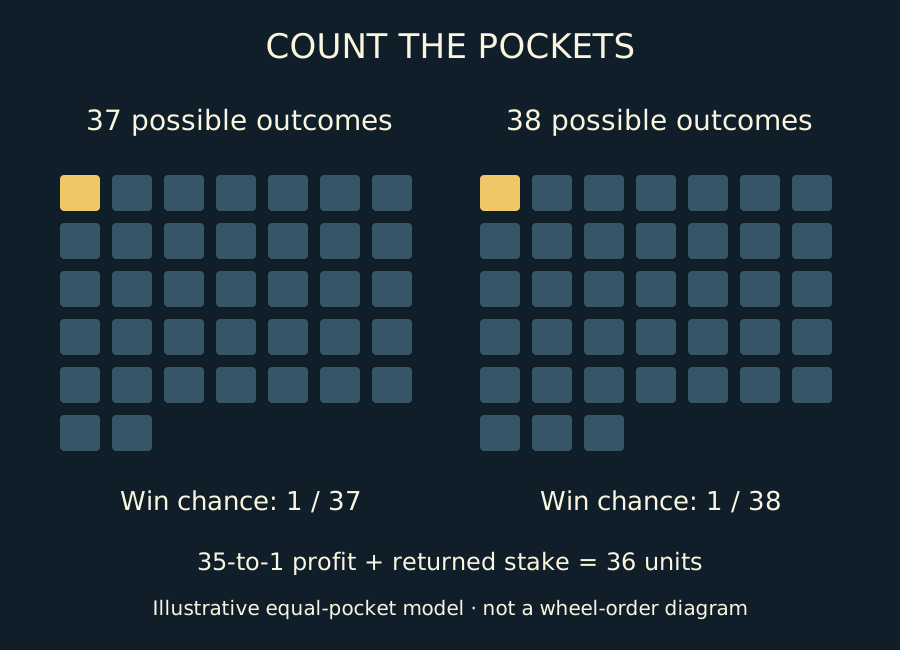
Online roulette rules: what changes the probability and payout?
Count the outcomes, separate profit from returned stake and read the zero rule before interpreting a roulette table or a run of results.
Read Online roulette rules: what changes the probability and payout?
Continue reading
Best free roulette payout chart: every bet’s edge, computed from the wheel
A roulette payout chart is only complete when it shows the true odds beside the payout, because the gap between them is the edge. Every standard bet, both wheels, the working, and a £10 cost per spin.
Read Best free roulette payout chart: every bet’s edge, computed from the wheelLa partage and en prison settle the same zero differently
Compare immediate half-refunds with held roulette stakes, follow a £20 settlement example and see why repeated-zero wording changes the question.
Read La partage and en prison settle the same zero differentlyStreaks and roulette strategies: are there any that work better on European wheels than American ones?
No. A run of reds is a record of spins that have already settled. The wheel sets the rate: 2.70% of every pound staked on a 37-pocket wheel, 5.26% on a 38-pocket one, whatever pattern the stakes follow.
Read Streaks and roulette strategies: are there any that work better on European wheels than American ones?Compare roulette wheel assumptions
The zero belongs in the calculation
European vs American roulette: what actually changes the odds
Best free roulette payout chart: every bet’s edge, computed from the wheel
La partage and en prison settle the same zero differently
Online roulette rules: what changes the probability and payout?