Wheel comparison
European vs American roulette: what actually changes the odds
A pocket count changes every bet's edge together. A zero rule changes only one bet type. Confusing the two is how "the wheels are basically the same" claims survive contact with the payout table.
Same game, two different legal objects
"European roulette" and "American roulette" are marketing shorthand for two differently specified objects. Massachusetts's published gaming rules describe a roulette wheel with a zero and a double-zero pocket, and set out exactly what happens to each bet type when the ball lands in either. French casino regulation describes a different wheel: Article 51 of the Arrêté du 14 mai 2007, the ministerial order governing French casino games, sets the game up as "roulettes à trente-six numéros et un zéro" — wheels of thirty-six numbers and one zero. (Légifrance's own page for this order did not return that article's text to us directly; the article number and wording are corroborated by an independent index of the same regulation rather than read first-hand from the government source — see the sources note below.) Nothing about a country label tells you which wheel a given table or online title uses; the pocket count and the zero-treatment clause do.
This matters before any percentage gets quoted. A "European roulette" game with an American-style zero rule, or vice versa, is not a contradiction — it is two independent design choices that happen to be badged with a place name. Read the two clauses separately: how many zero pockets, and what happens to which bets when the ball lands in one.
Sources: Massachusetts Gaming Commission: Roulette rules · Arrêté du 14 mai 2007 relatif à la réglementation des jeux dans les casinos, Article 51.
Count the pockets before you read the odds
Start with the plainest bet: a single number, paid at 35 to 1 on both wheel types in Massachusetts's published table. On a 37-pocket wheel, one number wins with probability 1/37 — about 2.7027%. A winning £1 stake returns £36 (£35 profit plus the returned stake); the expected value of that £1 is (1/37)×£36 = £0.973, a shortfall of £0.027, or 2.70% of the stake.
Run the identical sum on 38 pockets. The probability drops to 1/38 (about 2.6316%), and the expected value becomes (1/38)×£36 = £0.947 — a shortfall of 5.26%. Nothing about the £35-to-1 payout changed. The only input that moved was the denominator: one more losing pocket for the same prize.
Massachusetts's own rules give the payout figures used here — 35 to 1 straight-up, alongside 17 to 1 for a split, 11 to 1 for a street, 8 to 1 for a corner, 5 to 1 for a line, and 2 to 1 for a dozen or column. Every one of those numbers is designed to return exactly £36 for a £1 stake spread correctly across the covered numbers, which is the detail the next section turns on.
Sources: Massachusetts Gaming Commission: Roulette rules, Section 2(a).
Why every bet on a wheel shares one edge
Take a split bet: two numbers, paid 17 to 1. On a 37-pocket wheel it wins with probability 2/37, and a win returns £18 (£17 profit plus stake) for a £1 stake spread across the two numbers. Expected value: (2/37)×£18 = £0.973 — the same shortfall, 2.70%, as the single-number bet above. A street (three numbers, 11 to 1), a corner (four numbers, 8 to 1) and a dozen (twelve numbers, 2 to 1) all reduce to the identical £0.973 once the arithmetic is run, because every payout on the standard table is set so that (numbers covered) × (payout + 1) equals 36. That equality is what makes the wheel's edge a property of the wheel, not the bet.
This is the fact competitors covering this topic tend to bury under payout tables that only ever show the straight-up figure: on a wheel with no special zero rule, it does not matter which bet you choose. The house edge is fixed by the pocket count alone, and moving your stake around the layout changes your variance, not your expected cost.
The exception — and it is the whole reason this article exists rather than repeating the pocket-count point on its own — is a bet type that carries its own rule for what happens on zero. Even-money bets can carry exactly that rule, and where they do, the tidy equality above breaks.
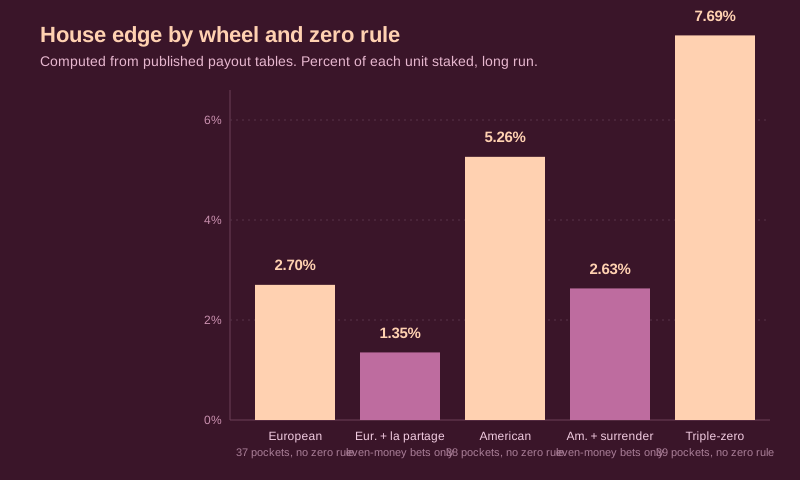
The payout and edge table
Below is every standard bet type against five wheel-and-rule combinations, with the edge worked from the payout and pocket count in each case rather than quoted from a third party. Where a zero rule applies, it is marked; it changes only the row it names.
| Wheel / rule | Straight (35:1) | Split (17:1) | Street (11:1) | Corner (8:1) | Line (5:1) | Dozen / column (2:1) | Even money (1:1) |
|---|---|---|---|---|---|---|---|
| European, 37 pockets, no zero rule | 2.70% | 2.70% | 2.70% | 2.70% | 2.70% | 2.70% | 2.70% |
| European, 37 pockets, la partage on evens | 2.70% | 2.70% | 2.70% | 2.70% | 2.70% | 2.70% | 1.35% |
| American, 38 pockets, no zero rule | 5.26% | 5.26% | 5.26% | 5.26% | 5.26% | 5.26% | 5.26% |
| American, 38 pockets, surrender on evens | 5.26% | 5.26% | 5.26% | 5.26% | 5.26% | 5.26% | 2.63% |
| Triple-zero, 39 pockets, no zero rule | 7.69% | 7.69% | 7.69% | 7.69% | 7.69% | 7.69% | 7.69% |
The working for the two zero-rule rows: la partage returns half the stake on a losing zero for an even-money bet, so on 37 pockets the expectation per £1 staked is (18/37)×£2 + (1/37)×£0.50 = £0.986, a shortfall of £0.0135 — 1.35%, exactly half the plain European figure. Surrender does the same on a double-zero wheel across two zero pockets: (18/38)×£2 + (2/38)×£0.50 = £0.9737, a shortfall of £0.0263 — 2.63%. Both figures fall inside the range independently reported for these rules elsewhere, which is a useful cross-check but not the basis for either number here; the basis is the arithmetic just shown.
La partage: the rule that halves one bet's edge
La partage — "the sharing" — is the convention under which an even-money bet that loses to zero returns half its stake rather than all of it. French casino regulation defines the single-zero wheel itself (Article 51, cited above); the la partage convention is an operator- and jurisdiction-level rule layered on top of that wheel, which is why it needs to be checked on the actual game's rules page rather than assumed from the word "European" in a title.
The mechanism only touches red/black, odd/even and high/low bets. A straight-up number, a split, a corner — anything that does not include zero in its own coverage — settles exactly as before: it either wins its stated payout or loses the full stake. That is the source of the asymmetry in the table above. On a wheel offering la partage, the smart move for edge alone is not a particular number or corner; it is choosing the even-money bet over any other, because it is the only bet whose edge the rule can touch.
Surrender: America's answer, and why it beats plain European
Massachusetts's published rules describe the equivalent mechanism for a double-zero wheel directly: "a player shall lose, at the gaming licensee's option, either one-half of each wager on red, black, odd, even, 1 to 18, and 19 to 36 or the entire wager" when the ball lands in zero or double zero. That "at the licensee's option" phrase matters — it is not guaranteed on every double-zero table, and the rules text for the specific game is the only way to confirm it applies.
Where it does apply, the arithmetic above puts it at 2.63% on even-money bets — lower than a plain European wheel's 2.70% on every bet type, despite starting from a wheel with one more losing pocket. The rule outweighs the extra zero for this bet type alone. That is worth sitting with, because "European is always better" is the shortcut most casual comparisons reach for, and it is not true of this specific combination once the option is confirmed present.
Sources: Massachusetts Gaming Commission: Roulette rules, Section 2(b).
Try it: change the wheel, watch every edge move
The worksheet below runs the same arithmetic as the table for a wheel and rule combination you choose, and lists every bet type's edge together. Watch which figures move in step and which one moves alone.
Worked, not simulated
Compare every bet's edge on one wheel
Assumes the standard payout table used throughout this article: 35:1 straight, 17:1 split, 11:1 street, 8:1 corner, 5:1 line, 2:1 dozen/column, 1:1 even money. It performs a fixed calculation from the option you pick; it does not read a live game, store a selection, or predict a spin.
Triple-zero and the limits of what we checked
A third zero pocket is not a hypothetical. Nevada's gaming regulator holds a published rules-of-play filing for a triple-zero roulette product ("Huxley Triple-Zero Roulette"), which is the regulatory record of a machine or device approved for a Nevada casino floor. We were not able to extract machine-readable text from that filing, so we are not quoting its payout clauses here — only citing it for the fact that a regulator-approved triple-zero wheel exists as a real, licensed product, not an internet rumour.
The 39-pocket edge figures in the table above are our own arithmetic applied to the standard payout table, not a transcription of that filing's specific numbers, and we have not confirmed whether any triple-zero title carries a surrender-style rule of its own. We also did not attempt an exhaustive check of UK Gambling Commission-licensed remote operators' catalogues for a triple-zero title; if you find one, its own rules page — not the wheel's name — is what tells you which row of this table actually applies.
Sources: Nevada Gaming Control Board: Huxley Triple-Zero Roulette, rules of play.
Reading a wheel before you bet
The UK Gambling Commission's remote technical standards require that a licensed operator make the applicable game rules "easily available to the customer before they commit to gamble," and separately require that bets be settled in line with those published rules. That gives you, as a reader, exactly two things worth checking on any online roulette title before treating a percentage you've read elsewhere as this game's percentage: the pocket count, and the exact wording of what happens to your bet type on zero.
Everything else in this guide — the equal-edge property, the la partage and surrender arithmetic, the triple-zero caveat — exists to make those two checks meaningful rather than mechanical. A pocket count changes every bet's edge together; a zero-rule clause changes one bet type and leaves the rest exactly where the pocket count put them. Neither fact is visible from a wheel image or a country name in a game's title.
For the underlying statistical ideas this article assumes rather than re-derives — independence between spins, and what an expected value actually claims to describe — Odds & Ends Lab holds the general explainer this site cites rather than repeats.
Sources: UK Gambling Commission: RTS 3 — Rules, game descriptions and the likelihood of winning · UK Gambling Commission: RTS 5 — Result determination.
Questions answered
What is the riskiest bet in roulette?
By house edge, none of the standard bets are riskier than another on a wheel with no special zero rule — a straight-up number and an even-money bet both cost 2.70% of turnover on a European wheel. By variance, the straight-up number is the "riskier" choice in the everyday sense: it wins far less often (1/37) for a far larger payout (35:1), so any given session swings much further from the average than an even-money bet does.
What is the smartest bet in roulette?
On a wheel with no zero rule, no bet type has a lower edge than another — "smartest" has no mathematical answer beyond matching the bet's variance to what you want from a session. Where a wheel does offer la partage or surrender, the even-money bets are the only ones whose edge that rule can lower, which is the one case in this article where a bet choice actually changes your expected cost.
Is roulette 100% luck?
Each spin is modelled as independent and equally likely across pockets, and UK-licensed remote games must settle results in line with their published rules rather than any pattern in past spins. No betting method changes that probability. What is not luck is the published rule set — pocket count and zero treatment — which fixes the expected cost of play before the wheel turns, and which this article is about reading correctly.
How much would I win if I bet £100 on red?
At 1:1, a winning £100 bet on red returns £200 (£100 profit) plus your stake back. On a European wheel with no zero rule that happens with probability 18/37 (about 48.65%); you lose the full £100 with probability 19/37. If the table offers la partage, the zero outcome (1/37) returns £50 instead of £0. On an American double-zero wheel the win probability falls to 18/38 (about 47.37%), and a surrender rule, where offered, would return £50 on 2/38 of outcomes instead of 1/38.
Rule sources
- Massachusetts Gaming Commission: Roulette rules (PDF) — retrieved 19 September 2026
- Légifrance: Arrêté du 14 mai 2007 relatif à la réglementation des jeux dans les casinos, Article 51 — retrieved 19 September 2026
- UK Gambling Commission: RTS 3 — Rules, game descriptions and the likelihood of winning — retrieved 19 September 2026
- UK Gambling Commission: RTS 5 — Result determination — retrieved 19 September 2026
- Nevada Gaming Control Board: Huxley Triple-Zero Roulette, rules of play (PDF) — retrieved 19 September 2026